The Most Important Word in CRE Right Now Isn't AI

The most important word in CRE right now isn't AI. It's place. It's always been place.
Let me explain how I arrived at that conclusion, and why it took a trip to Las Vegas to remind me.
I just came back from ICSC. Two sessions, moderated. Conversations in the hallways that were more illuminating than most of what happened on those hallways. And if I'm being direct about what the conference felt like this year? Ninety percent AI. Every booth. Every panel abstract. Every pitch over drinks at the Wynn.
I presented two sessions that both touched AI and location intelligence, so I'm not in any position to claim innocence. But somewhere between the third vendor demo promising to "transform your site selection workflow with agentic insights" and the fourth LinkedIn post I drafted asking whether AI was eating the competitive advantage in CRE, I hit a wall.
I'm AI-ed out. And I suspect I'm not alone.This isn't a column saying AI is overhyped or that the technology doesn't matter. I've written about the hype. Twice. What I'm saying is something different: the conversation has become so loud and so repetitive that the signal is completely buried by the noise. We've reached the point where "AI" in a headline is as meaningful as "synergy" was in 2008, or "omnichannel" was in 2015. A word doing a lot of work to say very little.
So this edition, I'm stepping away from it. Not because it isn't real. Because place deserves the conversation back.
The mall is not dead.
But the way we talk about it is.
Here's something I've been chewing on since Vegas. The retail real estate industry has spent so much time talking about transformation, disruption, and reinvention that we've largely stopped talking about the actual mechanics of what works.
Foot traffic is recovering in ways that the "retail apocalypse" narrative never accounted for. Not everywhere, not uniformly, and not for the same reasons in every market. But if you're looking at the data without an agenda, what you're seeing in markets like Greenville, Boise, Chattanooga, and Spokane is a quiet return to retail fundamentals: the right tenants, in the right places, serving the right people.
U.S. retail asking rents rose 2.4% year over year in Q1 2026, according to CBRE, even as tariff pressures and consumer sentiment weakened. That's not a market in distress. It's a market with constrained supply and redirected demand. Consumers are becoming more discerning, prioritizing value, essentials, experiences, and convenience. That's not a death sentence for retail real estate. It's a location intelligence problem. And location intelligence problems are solvable.
The barbell is real. Growth is increasingly concentrated in new and recently renovated properties in prime locations, followed by necessity-based retail, while mid-tier and aging assets struggle to remain competitive. That bifurcation isn't new. But the pace at which it's happening is.
What I'm watching:
Not AI tools. Not tech stacks. The things that don't trend on LinkedIn. Each of these is, at its core, a place story. Where closures are happening and why. Where consumers are still spending despite saying they won't. Where the next lease gets signed. Place is the variable that makes sense of all of it.
The closure math. More than 14,000 U.S. store closures are expected in 2026, and the names driving that number tell a very specific story: overextended balance sheets, expiring leases renewing at higher rates, tired concepts that have fallen into the "middle," and limited ability to absorb tariff cost pass-throughs. This isn't a demand crisis. It's a capital structure crisis wearing a retail costume. The real estate opportunity inside these closures is significant for landlords who understand what's happening and make the appropriate moves to allow specialization at the unit level, while they diversify at the portfolio level.
Consumer sentiment vs. consumer behavior. The University of Michigan's Consumer Sentiment Index hit a record low of 44.8 in May 2026, and 57% of consumers are spontaneously citing high prices as eroding their personal finances. But people are still spending. The gap between what consumers say they'll do and what they actually do is one of the most consistent and under-appreciated dynamics in retail. Consumers are predictably unpredictable. Location data is one of the few ways to watch behavior rather than survey it.
Tariff transmission. The supply chain conversation has been almost entirely absent from the CRE space, and I think that's about to change. Claire's raised prices and shifted inventory to offset higher tariff costs, which ultimately pushed sales lower and contributed to a bankruptcy filing. That's the transmission mechanism in action: tariffs raise input costs, retailers pass through what the market will absorb, volume falls, and weak leases get reconsidered. The CRE implications of that chain are significant, and many landlords aren't modeling for them.
The return of the specialty retailer. Not the mall-anchor version. Smaller. More specific. Built around a community of interest rather than a broad category. Resale, health and wellness, and concepts serving specific cultural communities with real spending power are where the interesting site selection decisions are happening right now. These are exactly the tenants that radius-based trade area analysis tends to undervalue.
A note on AI fatigue as a real industry signal.
When a technology becomes the loudest conversation in every room, one of two things is true: either we're at an inflection point where the technology is genuinely remaking everything, or we're at a peak where the narrative has outrun the reality.
I think we're closer to the second one right now. At least in CRE.
That's not bearish on the technology. It's bearish on the conversation.
The organizations that will actually extract value from AI in the next three years won't be the ones who talked about it most loudly. They'll be the ones who quietly figured out what specific problem they were actually trying to solve, found a tool that solved it without creating three new problems, and got back to making decisions.
The hype cycle is peaking. The shakeout is coming. When the dust settles, the CRE professionals who kept doing the hard, place-based work of actually understanding markets are going to be fine.
One More Thing.
This newsletter exists because I believe the most interesting questions in this industry sit at the intersection of place, consumer behavior, and data. Not any one of those. All three, together, where they get complicated and where the easy answers stop working.
AI can be part of that intersection. It has been. It will be again. But right now the AI conversation has gotten so loud that it's drowning out the place conversation, the consumer conversation, and the honest data conversation. That's what I'm pushing back on.
Not simpler analysis. Sharper analysis. Less noise around the tools, more signal about what they're actually finding.
AI isn't the most important word in this industry. It never was.
Place is. The corner of Main and Main is a real location. It always has been. And it's worth looking at clearly.
See you in two weeks.
- Gregg
IN THE NEWS
Consumer sentiment hits fresh record low in May as Iran war fuels inflation worries
"Consumer sentiment has tumbled to a fresh record low in May as fears of higher prices grow due to the U.S.-Iran war and elevated oil prices, the University of Michigan’s Surveys of Consumers said Friday."
Why Data-Driven Real Estate Is the Future of Development
"The window to build these capabilities before they become table stakes is narrowing."
Four questions for a private lender: How the market has moved from 'extend and pretend'
"Clearing legacy positions creates opportunities, Scott Douglass says"
"Marcus & Millichap (M&M), a commercial real estate (CRE) firm with 80 offices in Canada and the United States, has launched a Preferred Partner Program designed to connect its clients in the self-storage and other sectors with third-party service providers that support the CRE lifecycle."
Four Career Lessons for Commercial Real Estate’s Next Generation
"Success in the industry takes more than hustle. Stream Realty Partners’ Craig Wilson shares practical advice for young professionals entering the industry."
Nostalgic Retailer Spotlight:
AMES DEPARTMENT STORE
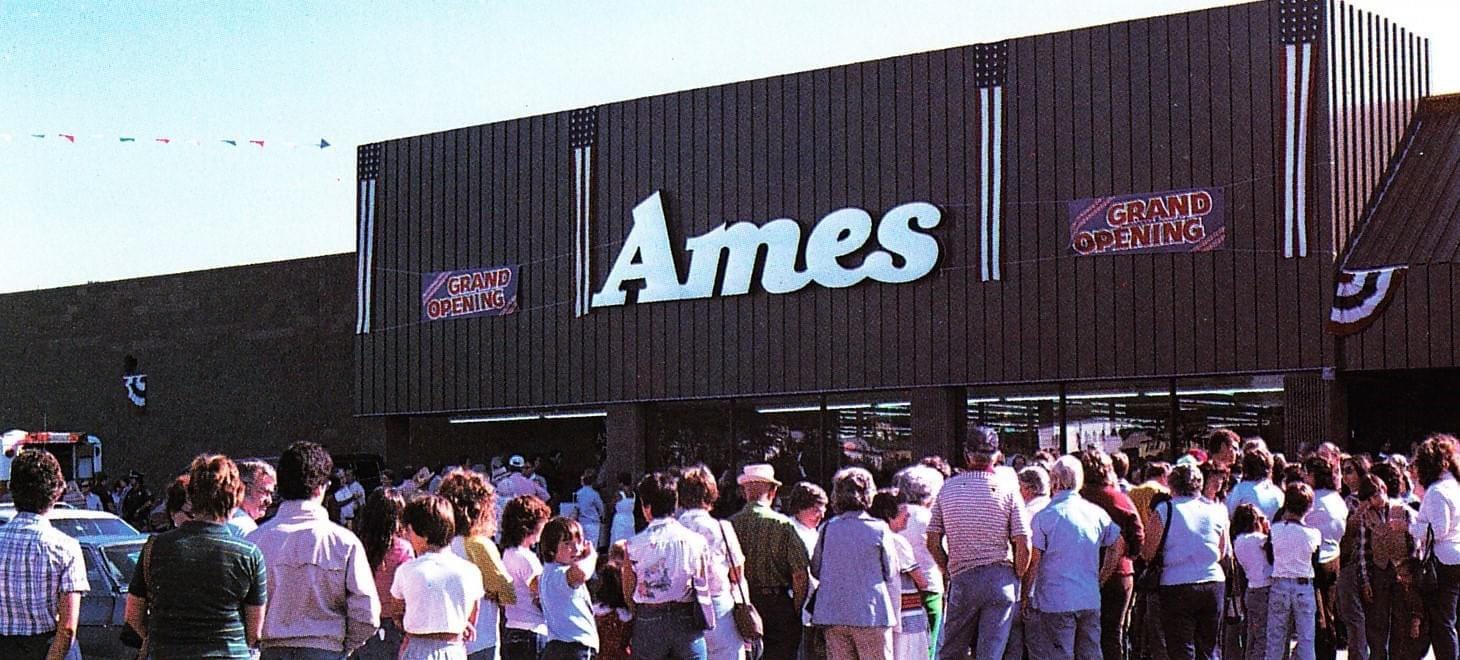
Before Target became the discount destination of choice for suburban America, there was Ames.
Founded in 1958 by Milton and Irving Gilman in Southbridge, Massachusetts, Ames grew from a single store into one of the largest discount department store chains in the northeastern United States. At its peak, Ames operated more than 700 stores, mostly in smaller markets and secondary cities that Kmart and Walmart hadn't yet prioritized. That regional focus was both its strength and its eventual vulnerability.
The CRE lesson in the Ames story isn't the bankruptcy. It's the acquisition.
In 1999, Ames purchased the Hills Stores chain, adding 200 locations and significant debt in a single transaction. The deal looked like a market share play. In practice, it was a lease liability play, and not in a good way. The Hills stores came with aging locations in markets with shifting demographics, leases that didn't pencil at the rents required to service the acquisition debt, and a store format that needed capital investment Ames couldn't afford to deploy.
The math broke before the brand did.
Ames filed for bankruptcy in 2001 and liquidated by 2002, closing all remaining stores. At the time, the narrative was e-commerce pressure and big-box competition from Walmart. Both were real. But the proximate cause was a real estate bet that didn't account for what was actually inside those trade areas.
The lesson that still applies: footprint expansion through acquisition inherits the location decisions someone else made, often under different economic conditions, with different consumer assumptions. Buying stores means buying their lease structures, their market positions, and their neighborhood trajectories. The due diligence that matters most isn't financial. It's geographic.
Secondary and tertiary market retail has always required a different analytical lens than primary market analysis. Ames understood its customer. It misjudged its real estate.