We Handed a Generation the Arrow and Took Away the Map
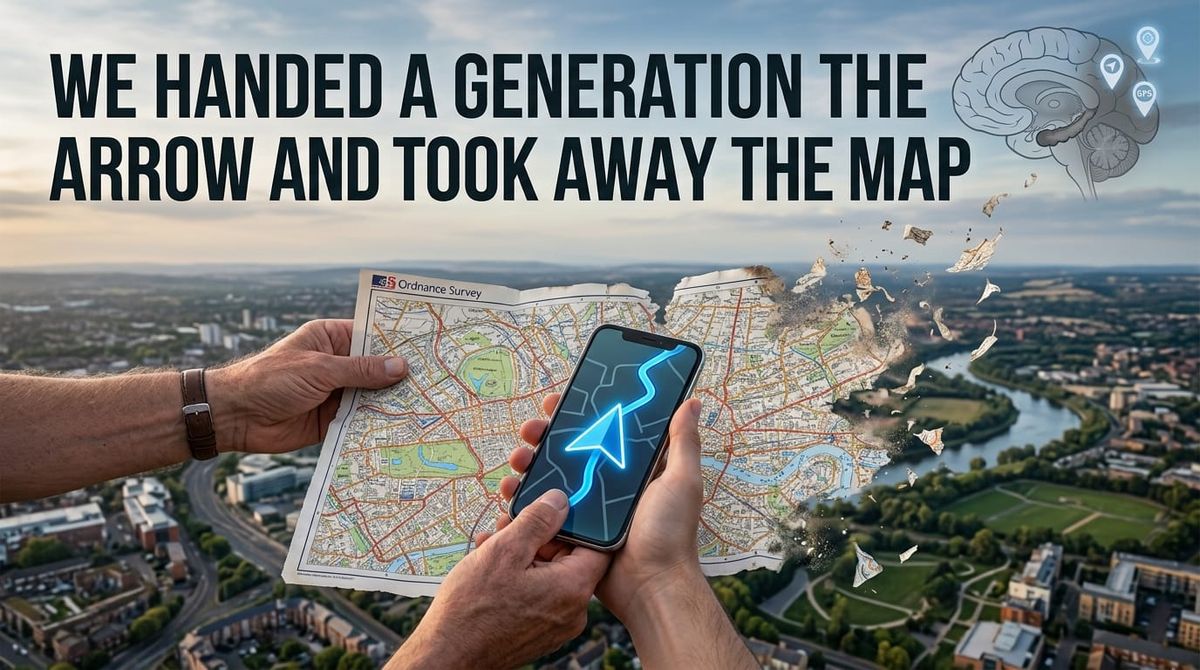
Only 18% of millennials say they can confidently read a paper map. For adults over 39, it is 44%. Ordnance Survey, the agency that has mapped Britain for more than two centuries, ran the survey, and the number underneath the headline is the one that stays with me: about one in seven millennials have never tried to read one at all.
You can wave that off as nostalgia. Paper maps went the way of the phone book, and good riddance. The problem is that the skill attached to the paper didn't move to the phone. It left. And a lot of people will never learn it at all.
The Part That Shows Up in the Brain
Researchers at McGill tracked 50 regular drivers and retested a group of them three years later. The heavier a person's GPS use across those three years, the steeper the decline in their spatial memory, the hippocampus-dependent kind you use to build a map of a place in your head. They checked the obvious objection, that people with a poor sense of direction simply lean on GPS more, and the data ran the other way. The heavy users had not started with a worse sense of direction. The reliance came first. The decline followed.
Use it or lose it, measured in gray matter.
Ask people directly and most say their sense of direction is fine. The brain scans and the map surveys tell a quieter story. And I include myself in it. I read places for a living, twenty years of trade areas and site visits and drive times, and I still catch myself following the blue arrow to a place I have already been, unable to tell you which way is north when I step out of the car. The arrow got me there. It also did my thinking for me, and I let it.
My partner at TSCG was a walking map. He refused to let his car or his phone navigate for him. He could describe a trade area he had driven once the way most people describe their own street, especially if it was "ITP" (Inside the Perimeter). Drop him anywhere, face him in any direction and he could tell you whether he was facing north, south, east or west.
The Arrow Knows the Way, Not the Place
Turn-by-turn navigation is one of the genuinely great tools of the century. The problem starts when you ride it as a passenger instead of driving it.
There is a difference between following a route and understanding a place. The arrow hands you the first for free. The second you have to build yourself, by reading the terrain, the landmarks, the way one street feeds the next, the reason the good corner is the good corner. That understanding is a skill. Skills that go unused get quietly repossessed.
That should sound familiar to anyone in this business, because it is a problem I have been circling for months in a different costume. The five-mile ring tells you people exist. The foot-traffic dashboard tells you a store is slowing. The AI assistant tells you which three options to consider. Every one of those tools answers where. None of them tells you why a place works. And if you have lost the ability to read a place yourself, you have no way to check the machine's answer. You just follow the arrow.
The Skill Leaders Can't Afford to Outsource
Here is where it stops being a curiosity about paper maps. The people making the largest decisions about physical places, where to build, where to sign, where to move the capital, increasingly make them through a screen that has already drawn the route. The demographics come pre-loaded. The trade area comes pre-drawn. The recommendation arrives with confidence attached.
We now have a generation of analysts who can pull a foot-traffic report in thirty seconds and many cannot tell you why the center across the street is dying. That is not their fault. We built a profession that rewarded the report and quietly stopped teaching the read.
A leader who can think in space can look at that recommendation and sense when it is wrong. A leader who cannot has to take it on faith. The first one is reading the map. The second one is following the arrow, at a scale where getting lost costs a great deal more than an extra fifteen minutes.
Call spatial thinking a soft skill if you like. It is the thing that lets you use every powerful tool we have built without becoming its passenger. We spent a generation making it optional. I think the next decade quietly makes it valuable again, precisely because so few people still have it.
The tools that tell us where have never been better. The open question is whether we still know how to read the ground they are standing on.
When was the last time you arrived somewhere and actually knew how you got there?