The Vendor Isn't Your Problem...Yet
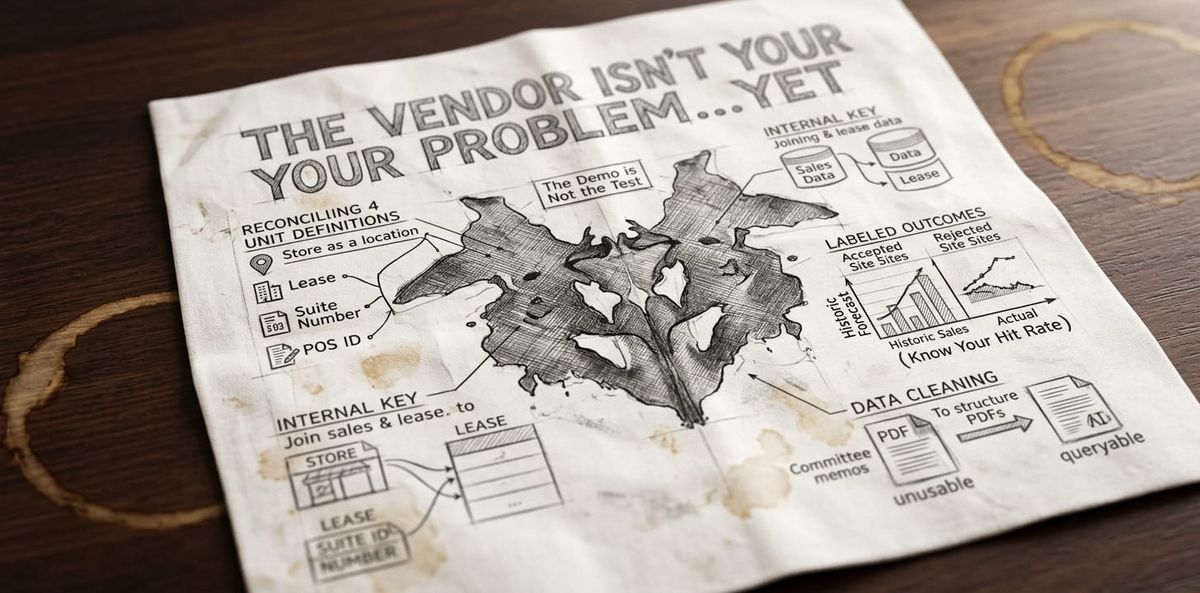
Walk the floor at any industry conference this year and do the subtraction. Count the AI booths. Then try to remember which ones were there last year, and go look up what happened to them.
Some got acquired. Some got quiet. Some are still selling the same demo with a new logo and a Series A that closed eighteen months ago and has not been followed by anything. And, it will be even worse next year!
I wrote about this in April and I stand by it. A lot of what is being sold as AI in this industry is a thin wrapper on a model somebody else built, priced like it took ten years of R&D. The shakeout is coming and it will be ugly for the people who bought at the top.
But I have started to think that this argument lets buyers off the hook. Because here is the uncomfortable version. If half these companies fail, that is a vendor problem. If you cannot tell which half, that is yours.
The Demo is Not the Test
Most AI evaluations in CRE go like this: the vendor shows you a market you know well. The output looks smart. Somebody in the room says "that matches my gut." Everybody nods. Procurement starts.
That is not an evaluation. That is a Rorschach test with a subscription attached.
The reason it happens is not that buyers are lazy. It is that most organizations do not have what they need to run a real test, and nobody wants to say so in front of a vendor.
Four Things That Have to be True First
Start with a single definition of the unit. What is a store? In a lot of companies it is a location in one system, a lease in another, a suite number in a third, and a POS ID in a fourth. Four answers, four counts, four different numbers in four decks. Point a model at that and you get a confident recommendation about a thing nobody in the building has agreed on.
Then an internal key you own. If joining your own sales data to your own lease data to any third party requires a person doing it by hand each time, that is the actual bottleneck. No model fixes it. Every model inherits it. And if your identifiers come from a vendor, your ability to switch vendors dies at the same moment your patience does.
Third, and this is the one almost nobody has. Labeled outcomes on the deals you did not do.
Everyone keeps the sites they opened. Almost nobody keeps a usable record of the sites they passed on, why they passed, and what actually happened at that address afterward. That means your history is a survivor list. Every model built on a survivor list comes back optimistic, and it will look terrific in backtest for exactly the reason it will disappoint in production.
If you want one project to start this quarter, start there. Go back three years, pull the sites your committee rejected, and find out what is operating there now and how it is doing. It is tedious. It is also the only asset in this whole conversation that a competitor cannot buy.
Fourth, know your own hit rate. What percentage of your last 20 openings hit the first-year sales forecast, and by how much did the misses miss? If you cannot answer, you have no baseline, and with no baseline every demo wins by default. A tool that is right 68% of the time is either a breakthrough or a downgrade depending entirely on a number most companies have never calculated about themselves.
You cannot grade a tool without a yardstick, and the yardstick is your own track record.
Which is Where AI Earns its Money
This is the part the skeptics skip, and I have been guilty of it too.
Once the floor exists, these tools are genuinely good. Not at the thing they are marketed for, but at the thing underneath it.
Reconciling four systems that disagree about what a store is. Reading 300 leases for a single clause and telling you which ones are ambiguous. Pulling structure out of a decade of committee memos that currently exist as PDFs nobody has opened since 2019. Getting your rejected-site history from unusable to queryable in weeks instead of never.
That work is not glamorous and no vendor leads with it, because "we will help you clean up your own mess" does not sell as well as "predictive site intelligence." It is also where most CRE teams would get the highest return in the next twelve months, and it happens to be work that survives the vendor's failure, because what you end up owning is your data in better shape.
Buy for the Day the Vendor Disappears
Assume the company you are signing with does not exist in three years. Then read the contract again.
The problem with vendor death in this industry is not the interruption. It is that the outputs outlive the company. A recommendation from a dead vendor's model is already sitting in an approved site package, a board deck, a lender submission. Nobody can re-derive it. Nobody remembers what it was fed.
So ask for the things that make that survivable. What inputs went into this output, and can I get them back. Can I reproduce this recommendation in 18 months without you. What happens to my data, my annotations, and my saved geographies on termination, in what format, at what cost. Which version of your model produced the number in this deck, and can you tell me later.
Every one of those questions is answerable. The reaction you get is itself the diligence.
I am not softening on the snake oil. Plenty of it is out there and a lot of people are going to write off a lot of software in the next two years.
I am saying the sorting problem is solvable, and the solution is not vendor diligence. It is having your own house in enough order that a bad tool has nowhere to hide.
Do you know your hit rate on the last 20 sites? Even the last 5?
IN THE NEWS
Frustrated US consumers cut their retail spending last month →
"Americans pulled back on their retail spending in July and their confidence in the economy is taking a hit. That’s a potentially troubling combination for a consumer-driven economy."
Blackstone and Brookfield are building their real estate tech in-house →
The largest owners in the business have looked at the vendor market and decided the build is worth it. The firms with the cleanest internal data are the ones least interested in buying somebody else's model, which is the whole argument above in one news item.
Spirit Halloween parent company to acquire Hot Topic →
"Hot Topic and its subsidiaries will continue to operate independently and will maintain their headquarters in California."
The Millennial Breakdown is Driving a Cultural Uprising →
"Walk into any Miniso, concert venue, or theme park, and you’ll see something similar: full-grown adults shamelessly reconnecting with the youth that shaped them. This is the foundational psychology behind a growing number of us Millennials, who are prioritizing spending based on a form of personal expression and autonomy once stripped away from us."
How Commercial Real Estate is Pricing on Yesterday’s Valuations →
"Issues such as Federal Reserve policies, climate-related risks, and rising insurance costs have been putting pressure on accurate commercial real estate valuations. This prompted Urban Land Magazine to ask economists: 'Do you think commercial real estate values are fully reflecting today’s costs and risks?' The unanimous response was “no,” but for different reasons."
Nostalgic Retail Spotlight: MEDIA PLAY
Want to browse the entire Nostalgic Retail Series and see back editions of The Corner of Main and Main? Click HERE

A $696 million acquisition that got handed away for zero dollars two years later. The strategy left. The leases stayed.
Four stores in one. Books, music, movies, and a video game section with demo stations where you could actually play before you bought. The first Media Play opened in Rockford, Illinois in 1992 at Forest Plaza and cleared $10 million in annual sales out of the gate. By 2000 the chain peaked at 89 locations across 19 states.
In January 2001 Best Buy acquired Musicland, Media Play's parent, for $696 million. The logic was reasonable on paper: a different demographic, a bigger footprint, over 1,100 stores in one transaction. Best Buy remerchandised, pushed Media Play toward games and DVDs, and shrank the book section.
Then the ground moved. Napster, Netflix by mail, the iPod, and Walmart and Target running CDs and DVDs as loss leaders. Best Buy's own stores started cannibalizing the boxes it had just bought. By 2003 Musicland posted a $238 million operating loss on $1.73 billion in revenue.
In June 2003, Best Buy sold Musicland to Sun Capital Partners in a cash-free transaction. No money changed hands. The entire value of the deal to Best Buy was that somebody else agreed to take the debt and the lease obligations. Two and a half years after paying $696 million, the winning outcome was getting the liabilities off the page.
Chapter 11 followed in January 2006. All 61 remaining Media Play stores were liquidated that December, along with 226 Sam Goody and 115 Suncoast locations.
Best Buy walked away. The landlords could not.