Two Retail Americas
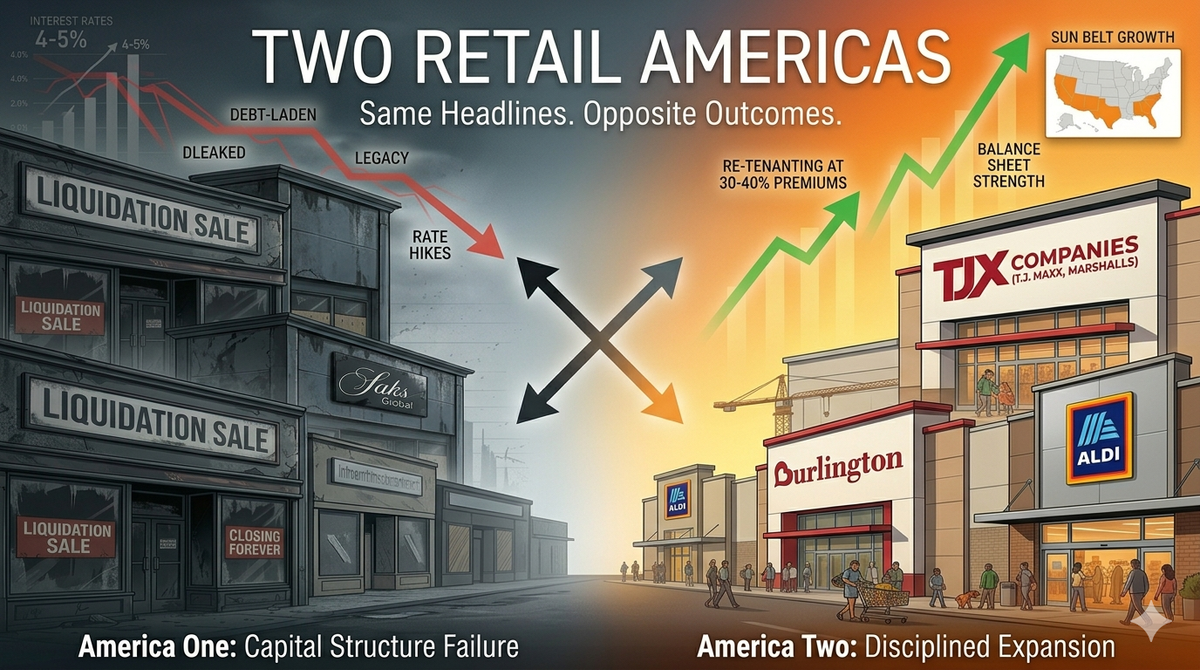
Same macro environment. Same interest rate cycle. Same headlines. Opposite outcomes, depending on whose balance sheet you're looking at.
Ask anyone outside this industry what happened to American retail last year and you'll get the same answer: it contracted. Joann liquidated. Party City liquidated. Rite Aid liquidated for the second time in nineteen months. Forever 21 closed all 354 of its US stores. Saks Global filed for Chapter 11 in January, dragging down a $2.7 billion luxury merger less than thirteen months after it closed. Claire's filed for bankruptcy protection for the second time in seven years. The issues are real. The framing is not.
Coresight Research counted 8,270 US store closures in 2025 against 5,270 openings, a net loss of roughly 3,000 stores. That sounds like collapse until you put it next to Coresight's own forecast from a year earlier: 15,000 closures. The actual number came in nearly half of what the industry had braced for, and below 2024's revised total of 8,825. For 2026, Coresight is now projecting closures to fall again, to roughly 7,900, which would be the lowest total in three years.
So what actually happened? Not the stupidly predicted "retail apocalypse," but a sorting mechanism. And once you separate the headline from the unit economics, two distinct Americas show up inside the same dataset.
America One is leveraged, legacy, and privately owned.
Saks Global's debt load traced directly to its $2.7 billion Neiman Marcus acquisition. Claire's first-day filings cited $30 million in 2025 tariff cost increases stacked on a debt structure built for a different rate environment. Forever 21's bankruptcy named Shein and Temu's use of the de minimis exemption as the single largest driver of more than $400 million in cumulative losses. This isn't a story about brick and mortar losing to e-commerce. It's a story about capital structures built for a near-zero rate world finally meeting a 4 to 5 percent Fed funds rate, and losing.
America Two is disciplined, off-price, and expanding directly into the wreckage.
Burlington added 104 net new stores in 2025, beat its own target, and has raised 2026 guidance twice since, most recently to roughly 115 net new stores. CFO Kristin Wolfe told analysts that 45 leases acquired out of the Joann bankruptcy estate were a direct driver of that raise, meaning a meaningful share of next year's Burlington store class will sit in boxes a struggling fabric retailer vacated twelve months earlier. TJX CEO Ernie Herrman has put the company's long-term US store potential at 1,900 additional doors, a total of 7,000, built on the same backfill logic. Aldi, Planet Fitness, and Five Below are running versions of the identical playbook in three different categories.
The real estate mechanics behind this are the part our industry tends to undersell. This isn't simply "store opens here, store closes there." It's a rent reset, and it shows up directly in landlord NOI. Kimco's leadership has reported roughly 90 percent of its Party City, Joann, Big Lots, and Rite Aid vacancies re-leased or under letter of intent at spreads averaging 30 to 40 percent over prior in-place rent. Brixmor posted full-year 2025 new-lease cash spreads of 38.7 percent. Simon Property Group took 38 Saks Off 5th leases that had been generating roughly $18 million in aggregate rent and is re-tenanting them at an estimated $30 million, a 67 percent mark-to-market. None of that appears in a closure headline. All of it appears in next year's earnings call.
This is the part worth sitting with if you underwrite, lease, or select sites for a living.
The closure count is the least useful number in the entire dataset. It tells you a box went dark. It tells you nothing about who is moving in, at what rent, or why.
The operating question isn't "is retail dying." It's "which operators have a real estate strategy, and which ones have a balance sheet problem wearing a real estate costume." Those are different diagnoses, and they call for different responses depending on whether you're the landlord, the lender, or the broker standing in front of either tenant.
Geography sharpens the picture further. Sun Belt metros, Charlotte, Raleigh-Durham, Phoenix, posted falling vacancy and rent growth above 4 percent through 2025, while several Rust Belt and population-stagnant metros saw vacancy climb 170 to 240 basis points, some with zero retail under construction to absorb the difference. Population trajectory, more than red state or blue state, is the variable that actually explains who captures the backfill cohort and who gets left holding a dark anchor box nobody wants.
American retail did not fall down in 2025. A specific, identifiable, mostly private-equity-financed slice of it did, and the operators with clean balance sheets and real estate discipline spent the year buying that real estate out from under them at a discount. That's not an apocalypse. That's a transfer, conducted in 12,500-square-foot increments, from weak hands to strong ones. The only mistake is reading the unit count and missing the trade.
ONE MORE THING
If you're underwriting, leasing, or site-selecting in 2026, stop asking which category is hot. Ask whose balance sheet can survive a rate environment built for adults. The closures will keep making headlines. The rent spreads are where the real story is being written.
IN THE NEWS
How Entertainment Tenants Are Rewriting Retail Real Estate. "Americans are spending more on fun. That might sound counterintuitive given where things stand with the economy: inflation has hit a 12-month high of 3.3% in March, driven by a sharp spike in energy prices that has lower- and middle-income households feeling the heat."
Forbes →
CRE lending competition hit an all-time high in April. A new JLL credit index, shared exclusively with CNBC, shows global lender competition and loan-term aggressiveness at record levels, driven by strong refinance demand and large data-center loan placements, with insurers and government agencies increasingly active in the mix.
CNBC →
Construction costs just posted their fastest pace of increase since the pandemic. Associated Builders and Contractors data shows input prices up nearly 10 percent year-over-year in May, with oil price spikes tied to the Iran conflict and continued tariff pressure on steel and copper named as the main drivers, a direct headwind to retail redevelopment economics.
Construction Dive →
Why CRE Firms Keep Spending Millions on AI and Getting Little Back. "Commercial real estate has entered the strange part of the AI cycle, where nearly everyone is experimenting, nearly everyone is paying attention, and many firms are spending real money on tools that, by most honest assessments, have not yet changed how the business actually runs."
Commercial Observer →
Foot traffic is holding positive heading into Prime Day 2026. Placer.ai's latest read shows major retail chains posting positive year-over-year visits through May despite consumer-sentiment headwinds, with Costco, Target, and Best Buy carrying existing momentum into the June 23 to 26 event while Walmart, Home Depot, and Lowe's lean on promotions to keep pace.
Placer.ai →
NOSTALGIC RETAIL SPOTLIGHT:
FILENE'S BASEMENT
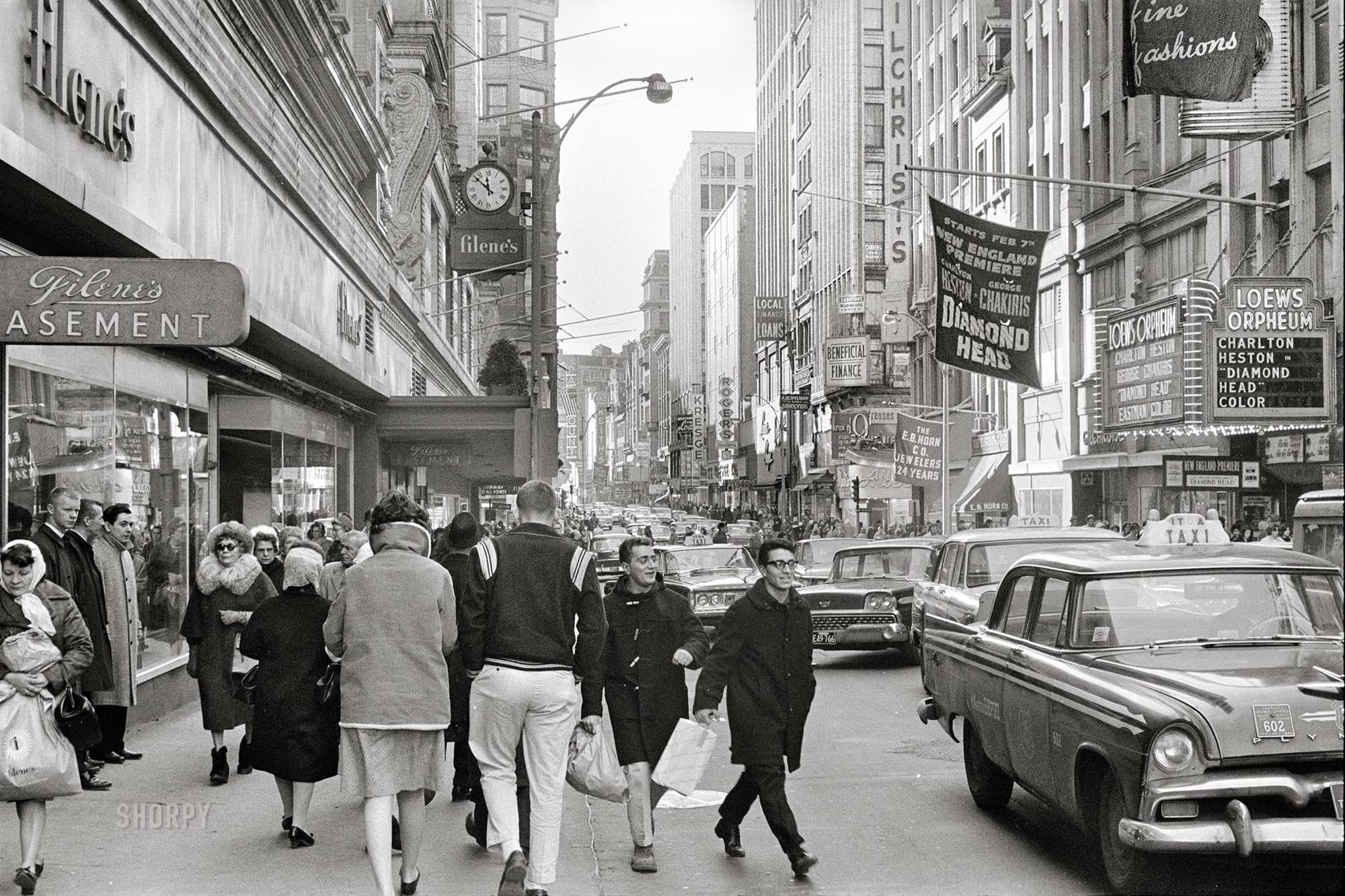
Before there was a Burlington, a TJX, or a Ross, there was a basement. Literally. In 1908, Edward Filene began selling his father's surplus and closeout merchandise in the basement of the family's Boston department store, using an automatic markdown system that became the blueprint for the entire off-price category. Filene's Basement didn't just participate in off-price retail. It invented it.
That pedigree wasn't enough to save it. Spun off from Federated in 1988, the chain changed hands repeatedly over the next two decades: acquired by Value City's Retail Ventures in 2000, sold off in pieces to liquidators starting in 2009, picked up out of bankruptcy by Syms Corporation for $62.4 million in June 2009, and finally shut down for good when Syms itself filed Chapter 11 on November 2, 2011. The last Filene's Basement stores closed on December 29, 2011, just over a century after Edward Filene's original idea.
Being in the right category was never sufficient. Filene's Basement had the category right, repeatedly, and the ownership structure wrong, repeatedly. Burlington and TJX are winning today's backfill race not because off-price is in fashion. They're winning because they paired the category Filene's invented with the balance sheet and real estate discipline Filene's never had for long enough.