Speed-to-Insights Isn't an Efficiency Metric. It's a Leadership Survival Metric.
Here's a pattern nobody's naming.
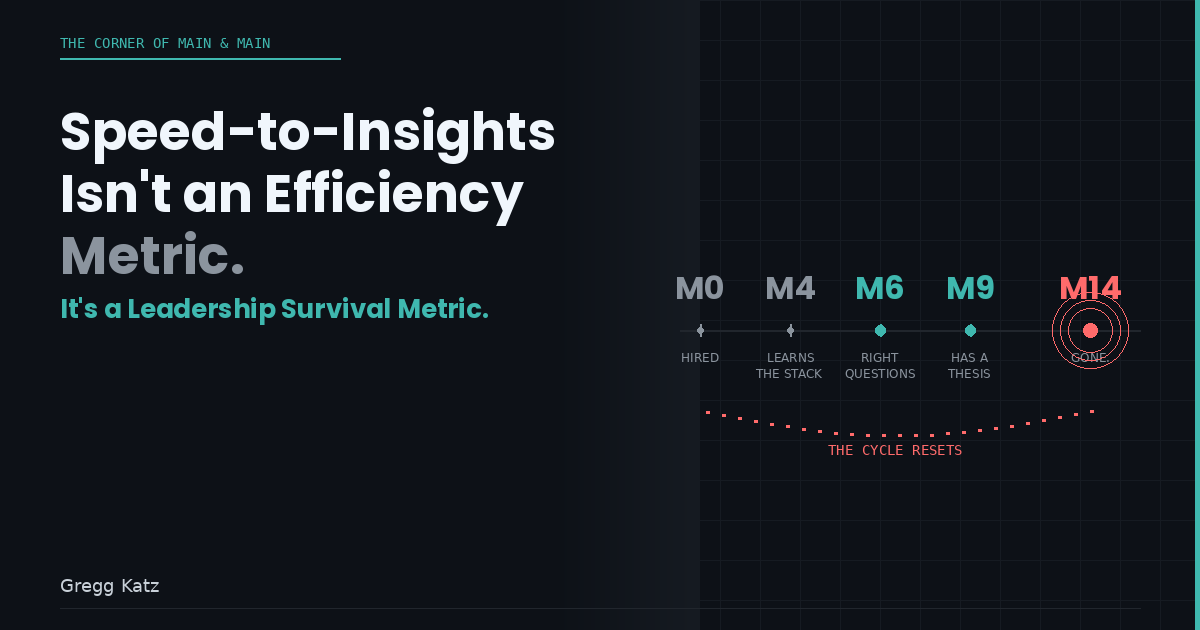
A VP of Real Estate or a CRO gets hired. They inherit a data stack. They spend four months learning what the platforms do, which ones to trust, which reports matter. Somewhere around month six, they start asking the right questions. By month nine, they have a thesis. By month twelve, they're building a case to act on it.
And by month fourteen, they're gone. The board lost patience. The pipeline didn't move fast enough. A new leader walks in and the cycle resets.
We call this a leadership problem. We call it culture. We call it "not the right fit."
I think we're misdiagnosing the disease.
The Real Bottleneck
The issue isn't that leaders are making bad decisions. It's that they can't get to good decisions fast enough. The time between "I need to understand this market" and "I can defend this recommendation to the board" is where careers stall and organizations churn.
That gap has a name. I call it speed-to-insights.
And in most CRE organizations, it's brutally slow. Not because the data doesn't exist. It does. There are 100+ platforms selling it. The problem is that the data arrives fragmented, unintegrated, and in formats that require a team of analysts to translate into something a decision-maker can act on.
So what happens? Leaders default to what's fast. Radius rings. Rooftop counts. Traffic numbers. The CRE 1-pager we've all seen a thousand times. Not because it's right, but because it's available. The industry doesn't optimize for accuracy. It optimizes for speed. And when speed and accuracy diverge, speed wins every time.
That's how you end up making million-dollar location decisions based on data that tells you people exist but nothing about whether they'll walk through your doors.
The AI Paradox
AI was supposed to fix this. Faster analysis. Automated site scoring. Instant trade area generation.
And in some ways, it has. The floor is rising. Tasks that took an analyst a week now take an afternoon. That's real.
But here's what nobody wants to talk about: AI hasn't shortened the time-to-decision. In many organizations, it's actually lengthened it.
Why? Because every new AI tool adds another input. Another dashboard. Another vendor demo. Another "proprietary" dataset that needs to be evaluated, integrated, and reconciled with the three platforms you already pay for.
I wrote recently that we're "solution crazy" in this industry. Mostly point solutions. Each one solves a slice. Foot traffic here. Demographics there. Personas in another tab. Competitive analysis in a fourth. The buyer is left stitching together a Frankenstein workflow that nobody fully trusts.
The result? More data, same speed. Sometimes slower. And leadership is still waiting for the answer.
What Speed-to-Insights Actually Requires
The organizations that move fast aren't the ones with the most tools. They're the ones with the clearest question-first discipline.
I wrote about this in the Data Deluge issue: the difference between a "Data-First" and a "Question-First" approach is the difference between aimless exploring and targeted hunting. That principle scales up. It's not just how you pick a dataset. It's how you build an entire analytics function.
Speed-to-insights requires three things working simultaneously:
Speed. Can you get from question to defensible answer in days, not months? If your process requires six handoffs between the research team, the analytics team, the GIS team, and the deal team before a recommendation reaches the C-suite, you've already lost the window.
Precision. Speed without accuracy is just faster wrong answers. The data has to be right, and it has to be applied to the right question. Two trade areas with identical demographics can have completely different spending behaviors. Precision means knowing the difference.
Interpretability. This is the one nobody talks about. The output has to be explainable. Not just to the analyst who built the model, but to the SVP who has to defend it in a board meeting. If the answer is "the AI said so," you haven't solved speed-to-insights. You've just moved the bottleneck from the analyst's desk to the boardroom.
When you get all three, leadership stabilizes. Not because the people are different, but because the organization can actually use what it knows. Decisions happen at the speed the market requires. Boards see results fast enough to keep conviction. Leaders stay in seat long enough to compound their strategies.
When you're missing any one of the three, the cycle repeats. New hire. Ramp period. Insight gap. Impatience. Departure. Reset.
The ICSC Question
Conference season is here. The expo floor will be packed with vendors selling speed. Faster dashboards. Automated reports. AI-powered everything.
Before you sign, ask one question: Does this tool shorten my time from question to defensible answer, or does it just give me more data to sort through?
Because the problem was never data scarcity. It hasn't been for a decade. The problem is the distance between having data and having an answer your leadership can act on.
Close that distance and you don't just make better decisions. You keep the people who make them.
IN THE NEWS
JLL: Global Real Estate Trends — May 2026
"An increasing bifurcation in spending patterns will contribute to pressure on mid-market retailers and lead to outperformance for premium and experiential segments as well as essentials."
CoStar: Q1 2026 Retail Investment Sales Hit Record
"First-quarter 2026 sales volume increased 31% compared to the same period in 2025, representing the strongest first three months of the year on record in total consideration."
ICSC: 11 Retail Real Estate Predictions for 2026
"New retail construction is expected to fall 37% in 2026. Disciplined development and strong tenant expansion activity will keep retail supply tight."
J.P. Morgan: 2026 Commercial Real Estate Outlook
"We're seeing the strongest valuations in a decade across active shopping centers, excluding regional malls."
Bisnow: Craft Brewery Slowdown Leaves Behind A Real Estate Hangover
A look at what happens when an experiential tenant category loses momentum and the landlords who leased to them face the fallout.
Nostalgic Retail Spotlight: BORDERS

In 1971, Tom and Louis Borders opened a used bookstore in Ann Arbor, Michigan. By the late 1990s, Borders Group operated over 1,200 locations (including Waldenbooks) and was the second-largest bookstore chain in America.
A Timeline:
- 1971: First store opens in Ann Arbor.
- 1992: Kmart acquires Borders. Rapid expansion begins.
- 1995: Spun off from Kmart as Borders Group, Inc. Goes public.
- 1998: Peaks at 1,249 locations with Waldenbooks.
- 2001: The fatal decision. Borders outsources its online sales operation to Amazon, believing e-commerce was a distraction from the in-store experience. Amazon gets the customer data. Borders gets nothing.
- 2004-2008: Invests heavily in CDs, DVDs, and in-store cafes as digital media consumption accelerates. The wrong bet, at the wrong time, at scale.
- 2006-2011: Five CEOs in five years. Each new leader inherits the same structural problems, spends months understanding the business, proposes a turnaround, and is replaced before the strategy can take hold.
- February 2011: Files Chapter 11. Closes 226 stores immediately.
- September 2011: Liquidation complete. All 399 remaining stores shuttered. 10,700 employees lose their jobs.
The Speed-to-Insights Lesson:
Borders is the cautionary tale for this issue. The leadership carousel wasn't the cause of the collapse. It was the symptom. Five CEOs in five years means the organization never had sustained strategic direction long enough to course-correct. Each leader needed 6-12 months to develop insights about what was actually happening. By the time they had a thesis, the board had already lost patience.
Meanwhile, Barnes & Noble, facing the same disruption, kept leadership stable long enough to invest in the Nook, build an e-commerce platform, and eventually pivot to a smaller, curated-store model under James Daunt. Same industry. Same headwinds. Different speed-to-insights. Different outcome.
The books were never the problem. The speed was.