Media Play - #38
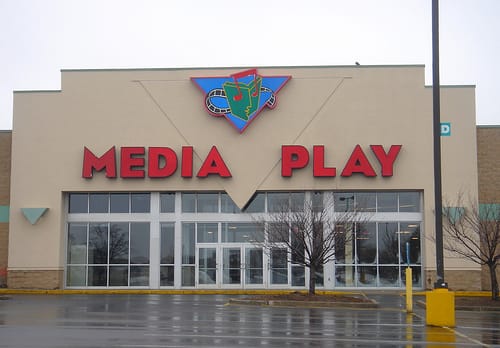
In 1992, Musicland Group saw an opportunity to revolutionize entertainment retail by creating a one-stop superstore that combined everything a media enthusiast could want: CDs, VHS tapes, video games, books, electronics, toys, anime, and more. The first Media Play opened its doors in Rockford, Illinois, at the Forest Plaza Shopping Center, and it was an instant hit, generating over $10 million in annual sales.
The concept was simple but brilliant. Why drive to a bookstore, then a music shop, then a video game retailer when you could find everything in one place? Each Media Play essentially housed four stores in one—a complete book section, a sprawling music department, an extensive movie collection, and a video game paradise complete with demo stations where you could actually play before you bought.
By 1995 with rapid expansion, Media Play had grown to 64 locations. The chain continued opening stores through the year 2000, eventually reaching a peak of 89 locations across 19 states.
Books and magazines made up 10-15% of sales, but the real draw was the comprehensive entertainment selection. You could find everything from mainstream hits to niche anime titles, from chart-topping albums to obscure indie releases. The chain launched an e-commerce site in 1999, getting ahead of the digital curve...or so it seemed at the time.
The Best Buy Era
In January 2001, electronics giant Best Buy acquired Musicland (which operated over 1,100 stores including Media Play) for $696 million. The purchase was part of Best Buy's strategy to diversify its retail holdings and reach a larger demographic with consumer electronics and entertainment products.
Best Buy launched major remerchandising campaigns and worked to transform the stores into destinations for young people seeking hip electronics. They converted Musicland's smaller "On Cue" concept stores (created for rural markets) into Sam Goody locations, and pushed Media Play more into video games and DVDs while reducing the book footprint.
The Perfect Storm
The early 2000s brought seismic shifts in how people consumed media. Napster and file-sharing services changed music consumption. Netflix launched its DVD-by-mail service in 1998 and streaming in 2007. MP3 players and iPods made physical music feel obsolete. Add in that Wal-Mart and Target discovered they could use DVDs and CDs as loss leaders and the fact that Best Buy's core stores, ironically, began cannibalizing Media Play's sales with aggressive pricing and Media Play could no longer profitably compete.
By 2003, Musicland reported a $238 million operating loss on $1.73 billion in revenues.
The Final Chapter
In June 2003, Best Buy sold Musicland to Sun Capital Partners of Boca Raton, Florida, in a cash-free transaction. Sun Capital acquired Musicland's debt and lease obligations, essentially taking the company off Best Buy's hands.
Failing to get the company "back on track," Musicland announced the closure and liquidation of all remaining 61 Media Play stores in December 2006, 𝗳𝗶𝗹𝗶𝗻𝗴 𝗳𝗼𝗿 𝗖𝗵𝗮𝗽𝘁𝗲𝗿 𝟭𝟭 𝗯𝗮𝗻𝗸𝗿𝘂𝗽𝘁𝗰𝘆 𝗶𝗻 𝗝𝗮𝗻𝘂𝗮𝗿𝘆 𝟮𝟬𝟬𝟲, and in February announced the additional closing of 226 Sam Goody and 115 Suncoast Motion Picture Company stores.
MediaPlay.com briefly continued as an online-only retailer for the remainder of 2006. In February 2006, Trans World Entertainment Corporation acquired the Musicland Group assets from bankruptcy, including the MediaPlay.com domain.