Where Did Site Selection Come From?
I decided to dig into the history and theory of site selection, wanting to write about it, but with brevity (and not with the old "walking though 5 miles of snow to get to school attitude).
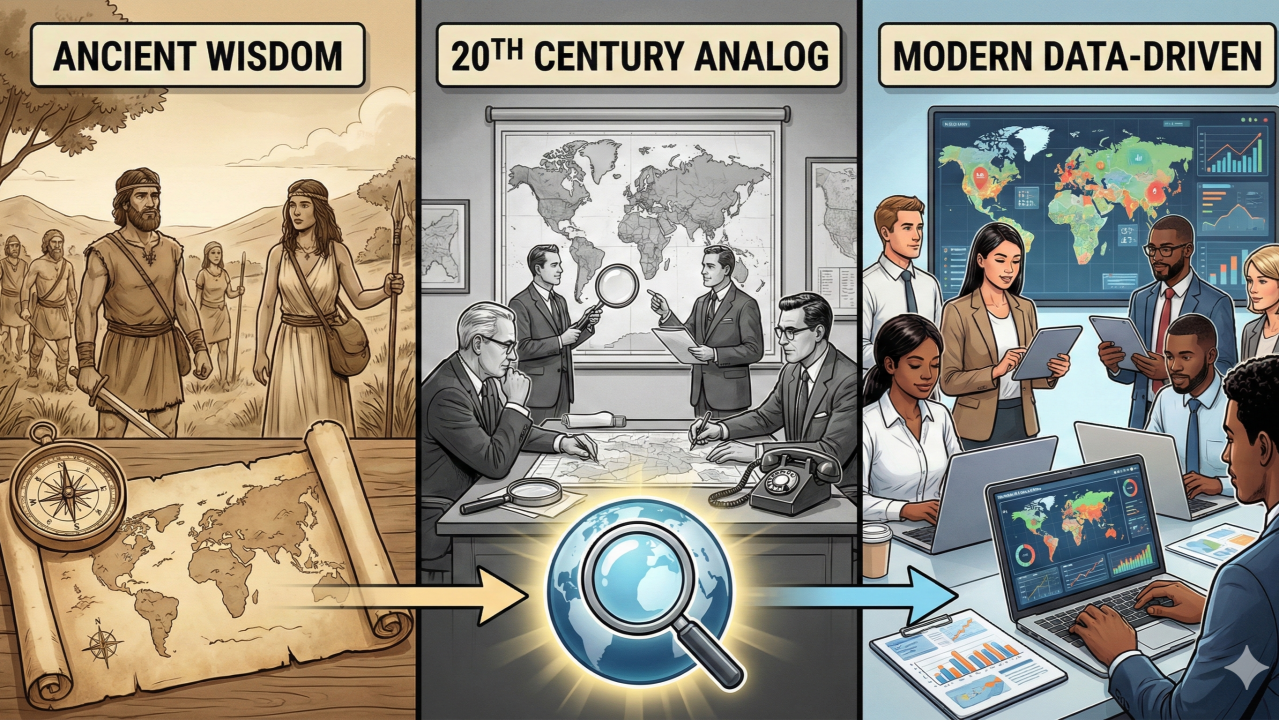
Site selection has significantly evolved over the years...part due to economic development and transportation technology, with a lot of changes related to improvements in technology and analytical methods. It did all start with "gut" decision making, something that cannot be lost in today's world of tech, data and AI.
Early Origins (Pre-Industrial Era)
The earliest forms of site selection were intuitive and based on obvious geographic advantages. Merchants established shops near marketplaces, ports, and town squares where foot traffic naturally concentrated. The fundamental principles were simple: proximity to customers, accessibility, and visibility. Medieval guilds often clustered in specific districts, creating the first commercial zones.
Industrial Revolution (1760s-1900s)
The Industrial Revolution transformed site selection into a more strategic process. Factories needed access to raw materials, water power, and transportation networks like canals and railroads. This era saw the first systematic consideration of multiple factors: labor availability, transportation costs, and proximity to suppliers. Retail followed population shifts to industrial centers, with department stores emerging in dense urban cores.
Early 20th Century (1900s-1940s)
Site selection became more formalized as businesses grew larger and more competitive. The automobile's rise fundamentally changed retail site selection, introducing considerations like parking availability and highway access. Appraisal methods became more sophisticated, and the first location consultants emerged.
William Applebaum, working for supermarket chains in the 1930s-40s, pioneered analog gravity models to predict store performance based on population density and competitor locations. William Reilly’s law of retail gravitation (1931) modeled how consumers choose centers, anticipating today’s trade‑area analytics. In parallel, economists like Edgar Hoover articulated criteria (labor, transport, markets) for industrial locations, providing a template for systematic evaluation.
Formalization in the 1950s–1970s
The practice “came of age” as the U.S. government developed national‑security facilities, using rigorous, multi‑criteria screening for projects like Los Alamos, Hanford, and the Air Force Academy. Those methods - criteria definition, community screening, site comparisons, and acquisition - migrated into the private sector with postwar expansion, shaping the modern stepwise process still described and used today.
Suburban sprawl created entirely new site selection paradigms. Shopping centers and malls required large land parcels with highway access. Demographic analysis became central, with businesses using census data to understand population characteristics, income levels, and purchasing power. Traffic counts and drive-time analyses became standard tools.

Data Revolution (1980s-2000s)
Geographic Information Systems (GIS) transformed site selection into a data-intensive discipline. Businesses could now layer multiple data sets (demographics, competitor locations, traffic patterns, zoning regulations) onto digital maps. Companies like Esri (yes...shameless plug) made sophisticated spatial analysis accessible. Retail chains developed proprietary models combining dozens of variables to predict site performance with increasing accuracy.
2000s-Present
Modern site selection moved from static, coarse inputs to high‑frequency, behavioral, and predictive analytics. Today’s workflows integrate mobile visitation patterns, POI context, competitive intensity, and block‑group demographics alongside traditional sales and traffic data to capture how people actually move and shop. GIS replaced simple rings with drive‑times and network analysis, while mobility data validates trade areas with observed paths and cross‑shopping.
What once required bespoke GIS is now productized in cloud platforms that blend data feeds, automate models, and expose insights to development, brokerage, and finance teams. Machine learning and GeoAI estimate sales lift, NOI, cannibalization, and success probabilities by combining mobility, demographics, competition, and macro indicators—supporting both market entry and network optimization.
The discipline is now continuous rather than episodic. This loop extends the original mid‑century framework: define needs, measure places against them, and iterate as conditions change, with far greater speed and granularity than ever before.
The process now typically involves multi-disciplinary teams including real estate professionals, data analysts, operations experts, and financial modelers. While technology has made analysis more sophisticated, the fundamental question remains the same: where will this location best serve customers while maximizing profitability? And, it is still, and will always be, a blend of the art and the science!
...LOCATION, LOCATION, LOCATION!
IN THE NEWS
The Future of Commercial Real Estate: Why Digital Marketplaces Are Here to Stay
"Shift Toward Digital-First Solutions Reflects Industry's Need for Smarter, Faster Transaction Tools"
Colliers releases report on 2026 Commercial Real Estate Outlook
"Renewed commercial real estate momentum defined by investor confidence, stabilizing fundamentals and easing financial conditions"
Commercial Real Estate Is Getting Too Cheap to Ignore (WSJ Subscription Required)
"After years of low returns, some portfolio managers are rethinking their commercial-property holdings"
How Visual AI Is Reshaping Value and Risk in Commercial Real Estate
"Professionals who understand and adopt this shift early will be better positioned to lead and win in the industry’s next chapter"
How Strategic Selectivity Is the Secret to Long-Term Retail Value Creation
"Today’s retail real estate sector is undergoing a drastic change. Annual retail construction completions are down more than 80% from mid-2000s levels, and that shortage favors developers with strong balance sheets, patient capital, and a track record of disciplined growth."
Nostalgic Retail Spotlight:
MARSHALL FIELD'S

Marshall Field’s roots trace to 1852, when Potter Palmer opened P. Palmer & Company in Chicago as an upscale dry-goods store focused on service and trust. In 1865, Marshall Field and Levi Leiter joined the business, and by 1881 Field had taken control and rebranded it as Marshall Field & Company.
By the early 20th century, the State Street flagship had expanded into a grand, full-block building that would become a National Register landmark, complete with the famous corner clock and ornate interiors. Experiences like the Walnut Room, elaborate window displays, and holiday traditions turned a shopping trip into a ritual for generations of Chicagoans and visitors.
In 1930, Marshall Field & Co. completed the massive Merchandise Mart, signaling its scale as both a retailer and wholesale powerhouse. Mid-century, the company led suburban expansion with locations in new shopping centers like Old Orchard in Skokie, aligning the brand with the rise of car-centric, regional retail.
From the late 1970s through the 1980s, Marshall Field’s added out-of-region stores and navigated takeover attempts, ultimately selling to BATUS Inc. in 1982. In 1990, Dayton Hudson Corporation (later Target Corporation) acquired the chain, investing in the State Street flagship and further integrating Field’s into a larger department store portfolio.https://www.youtube.com/watch?v=dAjuOQ7X7zA
In 2004, Target sold Marshall Field’s to May Department Stores; the following year, Federated (now Macy’s, Inc.) acquired May, setting up the nameplate conversion. On September 9, 2006, all Marshall Field’s stores were rebranded as Macy’s, a move that sparked local protests and underscored just how deeply the Marshall Field’s name, traditions, and experiences were woven into Chicago’s civic memory.
Even without its original banner, Marshall Field’s remains the standard for department stores, where architecture, service, and storytelling created emotional loyalty that outlasted the brand itself. Marshall Field's firsts included the department store tea room, the first European buying office, the personal shopper, revolving credit and the first department store to use escalators.