The Attention Economy: Reshaping Retail (the Consumer) and Real Estate

Let’s start with a simple idea: Information isn’t scarce anymore...Attention is.
We don’t live in a knowledge economy. We live in an attention economy.
Online, everything is designed to grab your focus:
- Platforms push outrage over nuance
- Brands chase clicks over connection
- Politics rewards extremes over problem-solving
Spectacle wins. “Softcore everything” wins.
That same fight for attention has quietly (or maybe not so quietly) moved into the physical world...Into stores, streets, malls, mixed-use projects, and every in-location experience.
The question isn’t “who can buy the most impressions?” anymore. It’s “who can EARN and FOCUS attention in a way that builds long-term value?”
How the attention economy shows up IRL
Walk any high street or mall:
Windows scream at you, A-frames clutter the sidewalk, LED boards compete with your phone, events, pop-ups, and QR codes everywhere
Most of this is built on a simple assumption: More stimuli = more attention = more sales.
But in a world of constant noise, more usually equals invisible.
The retail customer isn’t short on messages. They’re short on cognitive bandwidth.
In-location, that looks like:
- Shoppers walking straight past “hero” displays
- Families avoiding chaotic centers altogether
- Office workers eating at the same 3 safe places every week
The attention war is real.
But most players are fighting it with blunt-force volume, not precision.
Short-term footfall vs. long-term trust
When landlords, retailers, and brands optimize only for short-term footfall, one-off events, and/or clicky experiences built for Instagram, they often pay with eroded trust, fatigued visitors, and shallow, unpredictable sales patterns
Examples you’ve probably seen:
- Malls that spike traffic with constant events but have no reason to visit on a random Tuesday
- Stores that look great in photos but confuse people once they walk in
- Out-of-home campaigns that get “seen” by everyone and remembered by no one
Attention that is captured but not respected doesn’t compound.
The real compounding value comes from being predictable in a good way, relevant in a specific way, and calm in a noisy environment
That’s what builds: habit, trust and loyalty
Where location data changes the game
Online, we obsess over:
- Clicks
- Scroll depth (path on site)
- Time on page
Offline, we’ve historically had crude proxies:
- “Footfall was up 8%” (base data)
- “The car park was full” (visual - boots on the ground)
- “It felt busy” (gut)
But busy isn’t the same as attention. And attention isn’t the same as conversion.
Location data and in-place tech let us see:
- Where people actually move and dwell
- Which entrances and sightlines carry real attention
- Which zones over-index for target audiences, not just raw volume
- How campaigns translate into in-store or in-street behavior
Used well, this should change:
- Site selection: less “cheap rent + high traffic”, more “right audience + right flows + right context”
- Merchandising: fronting what earns engagement, not what the org wants to push
- Leasing: curating tenants that share and grow the same attention pool instead of cannibalizing it
- Media: paying for verified impact on real-world behavior, not just hypothetical opportunity to see
- Placemaking: designing for dwell, comfort, and clarity, not just aesthetic noise
Treat attention as a finite resource in physical space
The best retailers think about attention like this: Every sign, sound, smell, and interaction is a “spend” of the customer’s limited focus.
So they ask:
- What can we remove?
- Where are we confusing people?
- Where do we force unnecessary decisions?
- What should be unmistakably obvious as you approach a storefront?
Small shifts, big effect:
- Fewer, clearer messages at each decision point
- Hierarchy in signage: 1 thing to notice, not 7
- Reduced sensory overload at entrances so people can orient
- Dedicated quiet/comfortable zones that extend dwell instead of rushing people out
Respect attention and people stay, explore, and spend. Abuse it and they rush through or don’t come back.
Practical takeaways
For landlords / owners: Think about your asset as an attention system, not just a box with GLA.
- Where does attention naturally enter and flow? Do our leases and uses align with that?
- Which tenants EARN repeat visits and which only spike curiosity once?
- Are we over-programming events instead of building everyday reasons to come?
- Do our amenities reduce friction, or are they just photo ops?
Consider:
- Curating tenant mix around shared audiences and complementary use of attention
- Using data to identify dead zones, then solve with better uses, sightlines, or experiences
- Programming a reliable cadence of “anchors” (services, F&B, daily-use) before chasing spectacle
- Treating your common areas as your homepage: clean, legible, emotionally safe
For retailers / brands: Design experiences that deserve attention, not just demand it.
- Start with the journey: what should a first-time visitor understand in 5 seconds?
- Limit in-store campaigns running at once; prioritize 1–2 stories per zone
- Use digital screens sparingly and purposefully, not as wallpaper
- Align sensory elements (music, lighting, scent) with the actual mission of the trip
- Design for your real local audience, not just your global brand deck
Consider:
- If customers remembered only 1 thing from this visit, what would it be?
- Are you making it effortless to find, try, and buy?
- Would someone choose to linger here with no obligation to purchase?
For marketers: Your job is no longer just getting attention. It’s connecting in-feed attention to in-store, in-street, and in-site behavior. That means:
- Planning channels as one continuum, not separate silos
- Using location and visit data to see what content actually drives physical outcomes
- Valuing “boring” but consistent behavior (weekly visits, repeat routes) over viral spikes
- Building KPIs beyond impressions: store visits, dwell, path changes, repeat visit rate, tenant mix uplift
Instead of reporting “we reached 3M people,” ask:
- Did we change where they went?
- Did we change how long they stayed?
- Did we change what they did while they were there?
The real strategic advantage: managing and focusing attention
The edge now isn’t who can shout the loudest. It’s who can see where attention really lives, earn it consistently in their locations, and focus it on experiences that create real value for people
We’ve spent decades mastering how to buy attention. The next decade belongs to those who master how to deserve it.
IN THE NEWS
AI is changing the way we shop. Here's how retailers from Walmart to Sephora are experimenting with it. (subscription to access may be required)
"Major retailers, such as Walmart and Target, are integrating AI into their shopping experiences; Retailers have partnered with AI companies, such as OpenAI, and developed their own tools; AI assistants can help with product recommendations, checkout, and customer service."
"Meta, Google, xAI, OpenAI, Microsoft, and Amazon are planting hyperscale campuses across the heartland, turning farmland and factory shells into compute factories that rival cities in electricity demand."
Here’s what to expect for commercial real estate in 2026
"Experts and research firms forecast a year of stabilization and recovery for commercial real estate in 2026."
Five shifts that will redefine retail in 2026
"These changes are not five or ten years out. They are already taking shape and will accelerate meaningfully in 2026."
Healthcare CRE Experts Delve into Trends, Look to the Future (VIDEO)
"“Healthcare real estate has always been very stable. The stability, the gradual rent growth will continue,” Cox, Castle & Nicholson partner David Lari said at the recent Connect Healthcare Real Estate 2025 conference in Irvine, CA. What is changing, he continued, is the makeup of the investor pool for healthcare properties, with REITs currently shying away and healthcare providers stepping up, along with private equity firms and some sovereign wealth funds."
Nostalgic Retail Spotlight:
THOM McAN

For anyone who grew up in the 60s, 70s, or 80s, the familiar red Thom McAn sign was as much a part of the American mall experience as the food court and the fountain.
Ward Melville and J. Franklin McElwain opened the first Thom McAn store in New York City in 1922, named after Scottish golfer Thomas McCann. The concept was simple: quality shoes at a fixed, affordable price of $3 a pair. Just five years in, the chain had exploded to 300 locations across the country. By 1939, over 650 stores were operating nationwide, making Thom McAn synonymous with affordable American footwear through the Depression and into World War II.
Between 1952-1960, parent company Melville Corporation went on an acquisition spree, purchasing the 151-store Miles Shoes chain and creating Meldisco to supply shoe departments in discount stores. The strategy worked brilliantly. Melville became America's largest shoe retailer, operating 1,400 stores. Thom McAn, alongside Kinney Shoes, dominated the market as malls proliferated and the interstate highway system connected suburban America.
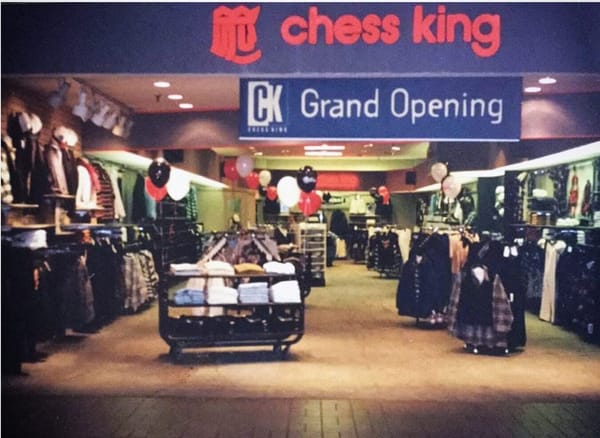
In the 1980s, Melville diversified into Chess King, Foxmoor, and CVS Pharmacy. But the first cracks appeared: six of seven footwear factories closed in 1983, followed by 72 store closures in 1985.
The Decline:
- Changing consumer tastes - Shoppers wanted trendy, not practical. They wanted Nike, Reebok, and designer brands, not dependable oxfords and Mary Janes.
- Import competition - Cheaper overseas manufacturing undercut Thom McAn's value proposition.
- Brand perception - Despite a late-90s marketing campaign (remember the duck saying "Change the shoes, Thom"?), the brand couldn't shake its reputation for being outdated.
By 1992, the retailer was down to 730 outlets. Melville announced it would close 350 stores. In 1996 the remaining Thom McAn stores closed their doors for good. About 100 locations converted to FootAction USA, while Melville spun off its footwear operations into a new company called Footstar to focus on its more profitable CVS division.
The Thom McAn brand didn't die...it just changed addresses. The shoes began appearing in Kmart stores through Meldisco-operated departments, later expanding to 1,500 Walmart locations in 2003.
"In 2005, Kmart owner Sears Holdings reached an agreement with Footstar – which by then was in bankruptcy and consisted almost entirely of the Meldisco-operated footwear departments inside Kmart stores – to let Footstar run the shoe departments through 2008, after which Sears would purchase the remaining inventory at book value. Sears Holdings acquired Footstar's intellectual property including the Thom McAn brand name." [Wikipedia]